

May 20, 2026
This week, I am in Detroit, Michigan, USA for the 2026 conference of the American Biogas Council (ABC). The ABC is a trade association that advocates for increasing the supply, demand, and quality of biogas across US industries and policies. I’ve met people at this conference from all around the US, and as far away as Germany, Barbados, and Japan!
I came to this conference with two goals. First, to identify potential funders and donors who want to support Solar C³ITIES’ work. And second, to find low-cost, low-energy technologies that are appropriate for micro-digester systems to monitor and upgrade the biogas we produce. Specifically, I’m interested in monitoring parameters like pH, temperature, and gas composition (especially methane content compared to CO₂, H₂O, and H₂S), and secondarily in monitoring the composition of the digestate or effluent (nitrogen, phosphorus, potassium, and coliform bacteria). In the realm of upgrading, we already have a quality, affordable way to scrub H₂S from our biogas, but not CO₂ or H₂O.
It’s inspiring to be surrounded by so many different clean energy technology solutions. The majority of the products on display here, though, are designed for large-scale industrial biogas operators. They’re much too expensive, heavy-duty, and energy-intensive for Solar Cities’ micro-scale “baby dragon” digesters. But maybe, just maybe, there are some useful treasures to be gleaned here…
Below are some photos from the expo hall with various different monitoring and upgrading systems. If you are aware of any other low-tech, small-scale alternatives for monitoring or upgrading, please let us know in the comments below!
Van Air Desiccant
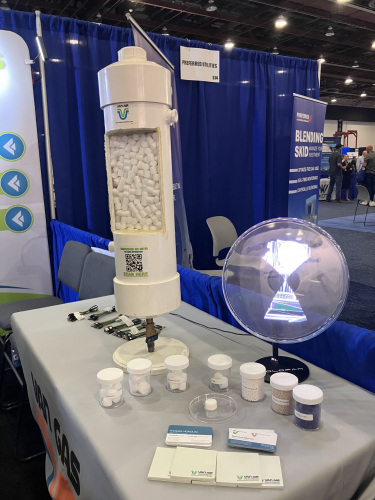
I met Thomas and Desmond from Van Air systems, also based in Pennsylvania! They occasionally work with families in rural Pennsylvania that have small fossil gas wells on their properties, and have designed their technology to be appropriate for that scale of use. The size, cost, and simplicity are much closer to Solar Cities micro-digesters than they are to industrial-scale dairy farm or landfill digesters. We had a great conversation and I was very impressed with the ability of their desiccant pellets to pull moisture "out of thin air" on the expo hall floor! Pulling water out of biogas is important for a number of reasons: gas that is dryer burns hotter, and water in gas can cause corrosion if the gas were to be stored in a metal tank such as a propane cylinder. A more common low-tech solution for pulling moisture out of biogas is to use cat litter. I'm curious to test how this product compares to that in terms of cost-effectiveness...