

May 20, 2026
This week, I am in Detroit, Michigan, USA for the 2026 conference of the American Biogas Council (ABC). The ABC is a trade association that advocates for increasing the supply, demand, and quality of biogas across US industries and policies. I’ve met people at this conference from all around the US, and as far away as Germany, Barbados, and Japan!
I came to this conference with two goals. First, to identify potential funders and donors who want to support Solar C³ITIES’ work. And second, to find low-cost, low-energy technologies that are appropriate for micro-digester systems to monitor and upgrade the biogas we produce. Specifically, I’m interested in monitoring parameters like pH, temperature, and gas composition (especially methane content compared to CO₂, H₂O, and H₂S), and secondarily in monitoring the composition of the digestate or effluent (nitrogen, phosphorus, potassium, and coliform bacteria). In the realm of upgrading, we already have a quality, affordable way to scrub H₂S from our biogas, but not CO₂ or H₂O.
It’s inspiring to be surrounded by so many different clean energy technology solutions. The majority of the products on display here, though, are designed for large-scale industrial biogas operators. They’re much too expensive, heavy-duty, and energy-intensive for Solar Cities’ micro-scale “baby dragon” digesters. But maybe, just maybe, there are some useful treasures to be gleaned here…
Below are some photos from the expo hall with various different monitoring and upgrading systems. If you are aware of any other low-tech, small-scale alternatives for monitoring or upgrading, please let us know in the comments below!
EcoVapor
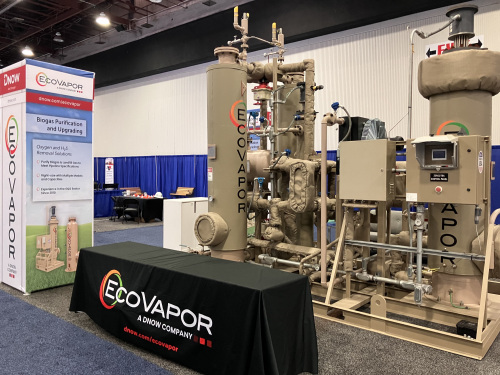
EcoVapor sells equipment to monitor biogas (parameters like pressure, pH, temperature, and contaminant levels) and to upgrade it into biomethane (by removing impurities like hydrogen sulfide, water, and carbon dioxide). This rig may seem large, but it was one of the smallest and most compact systems on the expo floor! I stopped by the EcoVapor booth and told them about Solar Cities' work and mission, and they were delighted to hear more. Hans, Marcus, and I chatted about possible low-tech, low-energy solutions to remove water vapor and carbon dioxide from biogas. They recommended looking into membranes (PSA, pressure-swing adsorption, or TSA, temperature-swing adsorption). Another conference attendee recommended bubbling the biogas through a hydroxide solution (potassium, magnesium, or calcium hydroxide) to remove the CO2. A third conference attendee told me very gravely that what I am looking for is impossible 😂