
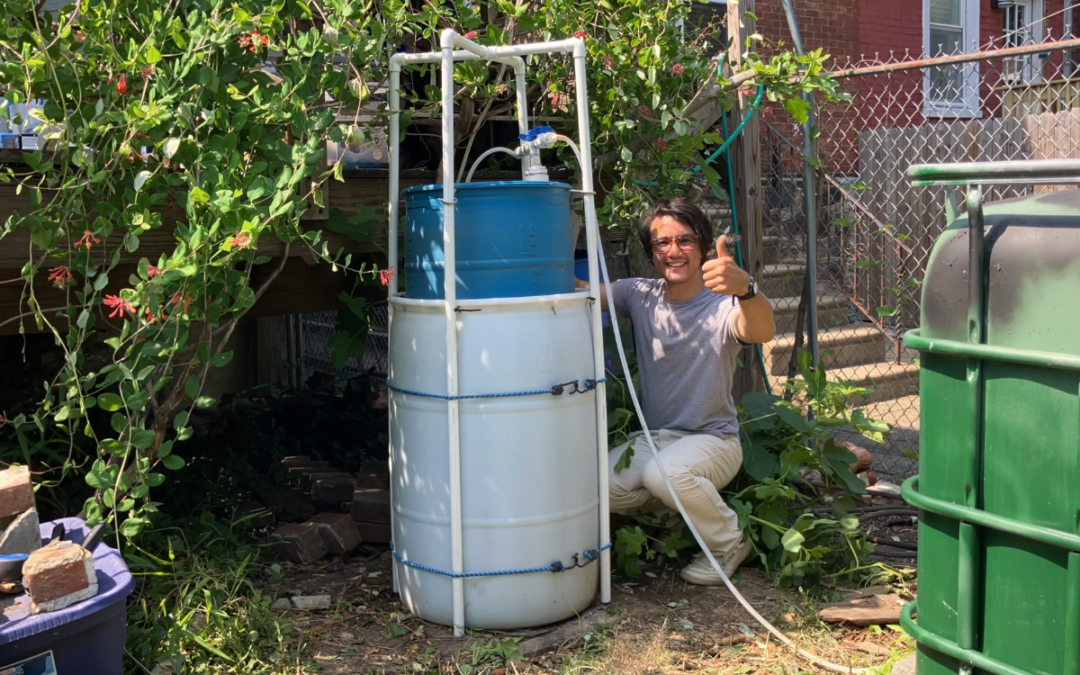
There are many ways to store biogas after it is produced. The biodigester itself can store some gas, but often we want to be able to store excess gas for later use or longer cooking times. Also, storing biogas within the biodigester itself can raise air pressure within the biodigester, which can depress the chemical reaction that produces the gas, leading to decreased yields. Higher pressure within the biodigester can also make leaks more likely, and more leaky. (For more detailed discussion of these topics, see David House’s “The Complete Biogas Handbook”, especially chapter 14.)
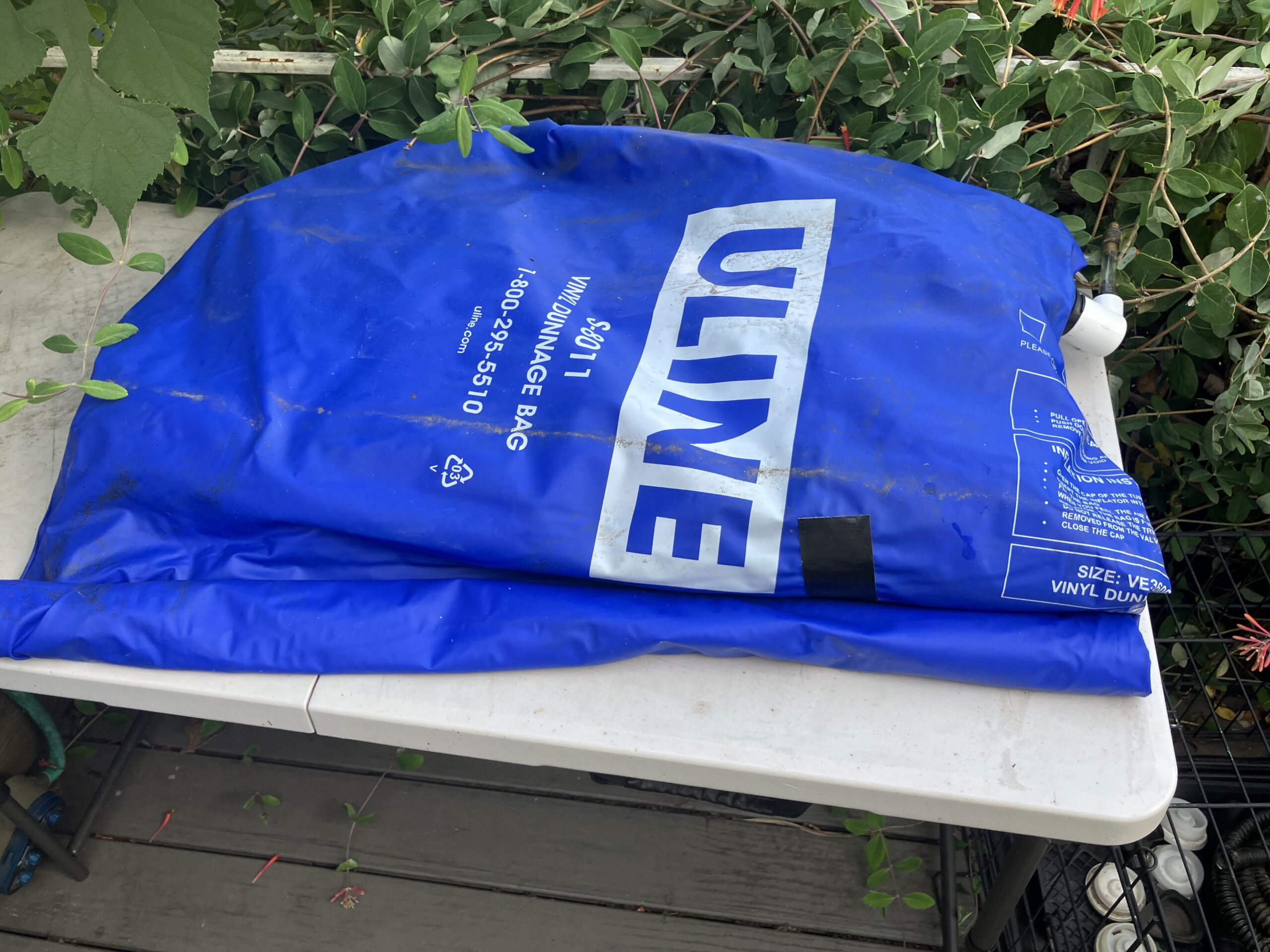
Vinyl dunnage bag (ULINE S-8011), 9.8 mil thickness – but it sprang a leak!
When Janice first helped me install my biodigester, she generously provided this gas storage bag. It’s advertised as way to stabilize shipments, kind of like industrial-strength bubble wrap. But shortly after installing it, I noticed the bag was leaking, so I decided it was time to upgrade to a more durable form of gas storage.
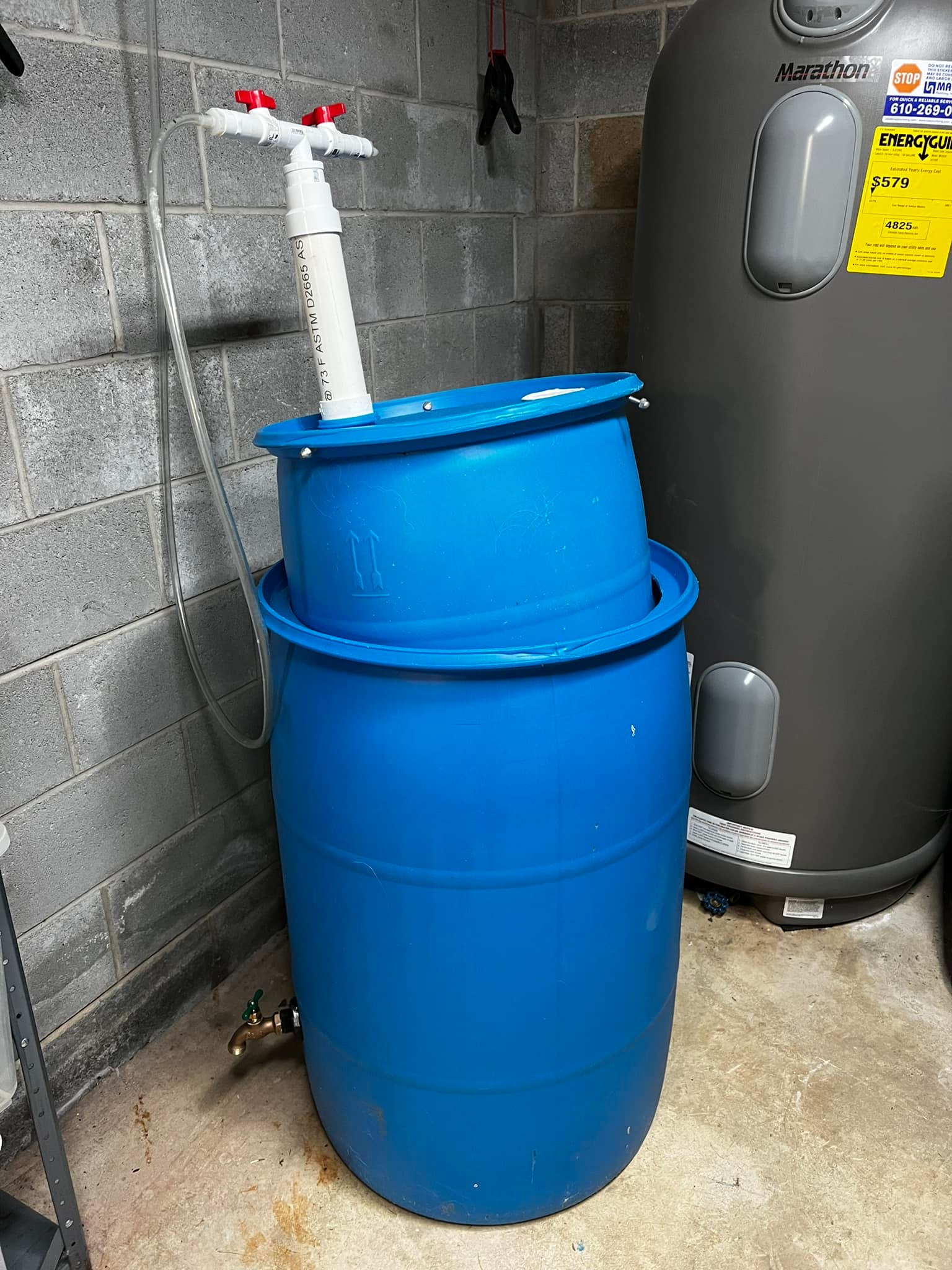
Basic model for floating barrel gasometer.
This is the basic template for a “floating barrel”-style gasometer. It consists of two nested HDPE drums, 55 gallons and 30 gallons. In theory, the smaller barrel (which floats on top of water in the larger, lower barrel) can hold up to 30 gallons of gas, but in practice the amount is slightly lower because a few inches of the barrel must remain submerged to keep the gas contained. Notice that in this model, which lacks a PVC stabilization “skeleton”, the barrel floats at an angle. At lower gas volumes, this isn’t a problem, but as the gas accumulates, you want your barrel floating more-or-less level with the ground to prevent “burps” or gas escapes. A level-floating barrel also enables easier measurement of the gas volume; and if you (like me!) use the dirt-simple “bricks / rocks on top” method to pressurize and pump the gas to your stove, a level barrel is also very helpful!

PVC valves, junctions, and adapters to connect the 30-gal HDPE storage barrel’s threaded opening to our 3/8″ vinyl gasline
The 30-gal HDPE barrel usually includes a 2″ threaded opening, which must be adapted to fit with our 3/8″ vinyl tube that carries the biogas. The picture above shows one way to make such an adaptation, but there are other ways based on which PVC fittings and adapters are available in your area.
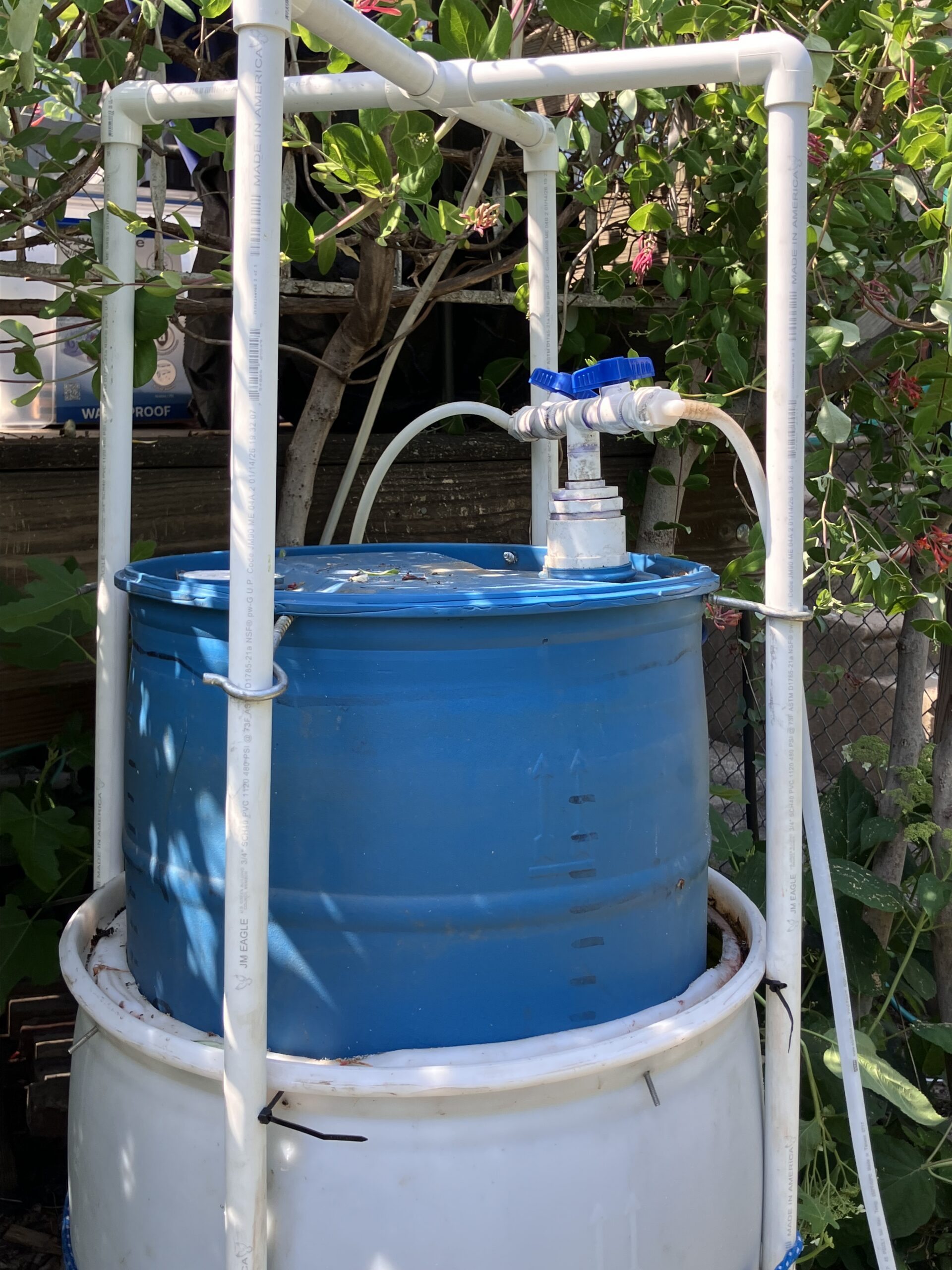
Floating gas barrel storage with stabilizing PVC exoskeleton
My finished design includes a stabilizing PVC exoskeleton to keep the barrel floating level. Since this pipe doesn’t store any gas, the exoskeleton can be dry-fitted without any glue or adhesive. I used 1″ PVC pipes cut to 5-foot lengths, resting on the ground. In retrospect, these pieces could have been cut slightly longer, because the T-connection on top of the barrel bumps into the exoskeleton and prevents the barrel from rising to its full height. Alternatively, I might add a couple of 90-degree elbows between the T-connection and the rest of the gasline to keep the valves out of the way of the exoskeleton. I used UV-resistant nylon zip-ties, as well as two bungee cords, to hold the PVC skeleton in place. At the four tangent points where the vertical pipes meet the 55-gallon HDPE barrel, I sanded down the rim of the barrel to create a flat (or slightly concave) groove for the pipes to seat in. I also used four open-ended eye bolts, screwed into the top rim of the upper 30-gallon barrel, to hook the floating barrel to this stabilizing frame. I had to slightly bend the open end of the eye-hooks to keep them tight enough around the PVC to be stable, but loose enough to slide freely as the barrel rises and falls. I also use Mosquito Dunks (1/4 of a tablet) to prevent mosquitos from breeding in the standing water.
I’m excited to use this new, level-floating barrel to more accurately measure how much gas my biodigester produces! How do you store your biogas? Share some information or photos in the comments!