
This week, Janice and I traveled to Maryland to visit Pat and Bill, a retired couple who live part-time in a tiny house that Bill built on top of a trailer bed. Solar CITIES had installed a biodigester for them over a year ago, but Pat and Bill haven’t used the gas yet because they weren’t sure if it was working properly. Their biodigester is only about 2 hours away, so Janice and I traveled there to perform a biodigester check-up.
We brought some digestate with us – the fully digested liquid that flows out of a biodigester along with biogas. Anerobic digestion produces both biogas and liquid digestate, which is often applied to crops as a form of fertilizer. In addition to nutrients, digestate also contains microbes – bacteria and archaea – that are essential to the biodigester’s healthy functioning. Much like our own digestive systems, biodigesters require a healthy population of diverse microbial life. If Bill and Pat’s digester wasn’t producing gas, it’s possible that an infusion of microbes from a healthy digester could jump-start the biochemical process.
Bill has a background in construction, so he was keen to share the off-grid features he has built into their tiny house: a composting toilet, rainwater catchment and filtration, and an AC/DC electrical system with batteries and an inverter. They have a solar array and a greenhouse as well. In fact, the first thing Bill told us about his digester was that he had just moved it to a sunnier location. Biodigesters thrive in a temperature range similar to the human body, 98 F / 37 C. They can also function even more efficiently at higher temperatures, between 120-150 F – the so-called thermophilic range. A biodigester in the shade will not produce as much gas.
And indeed, just looking at their IBC tank, it was clear that the digester was producing gas. The top was bulging with air pressure. But sometimes, the first gas produced by a digester isn’t yet flammable – it can be lower in methane and higher in carbon dioxide if the tank still contains some oxygen, making the reaction aerobic rather than anaerobic. So Janice and I decided to do a flame test to check if the gas is burnable. This is tricky in daylight conditions because the biogas flame itself isn’t visible in sunlight. From dusk till dawn, a biogas flame will emit a cool blue light with flecks of orange, but during the daytime, the flame is only visible in subtle distortions of heat waves rising through the air. So we had to get creative.
Janice grabbed a dry stalk from the forest floor and held it a few inches away from the gas outlet. I opened the gas valve and provided a pilot light, with the gas nozzle pointing towards the dry stalk. When I opened the valve, we could hear the whooshing pressure of the gas, and smell it as well. As soon as I lit the pilot light, flames jumped from the gas valve to the dried plant. Flame test: passed!
No doubt, this sunnier new location was providing enough heat for Bill and Pat’s digester to produce biogas (although as you can see from the photos and video, it’s still partially shaded). We poured in about 15 gallons of digestate into their tank anyway, which served two purposes: increasing the microbial population of the tank, and displacing volume in the tank to drive up the gas pressure and push out more gas. We helped Bill and Pat connect a vinyl bag to his gas outlet to capture the gas. They may move the digester to an even sunnier location, and are excited to use the biogas to cook in their tiny house!
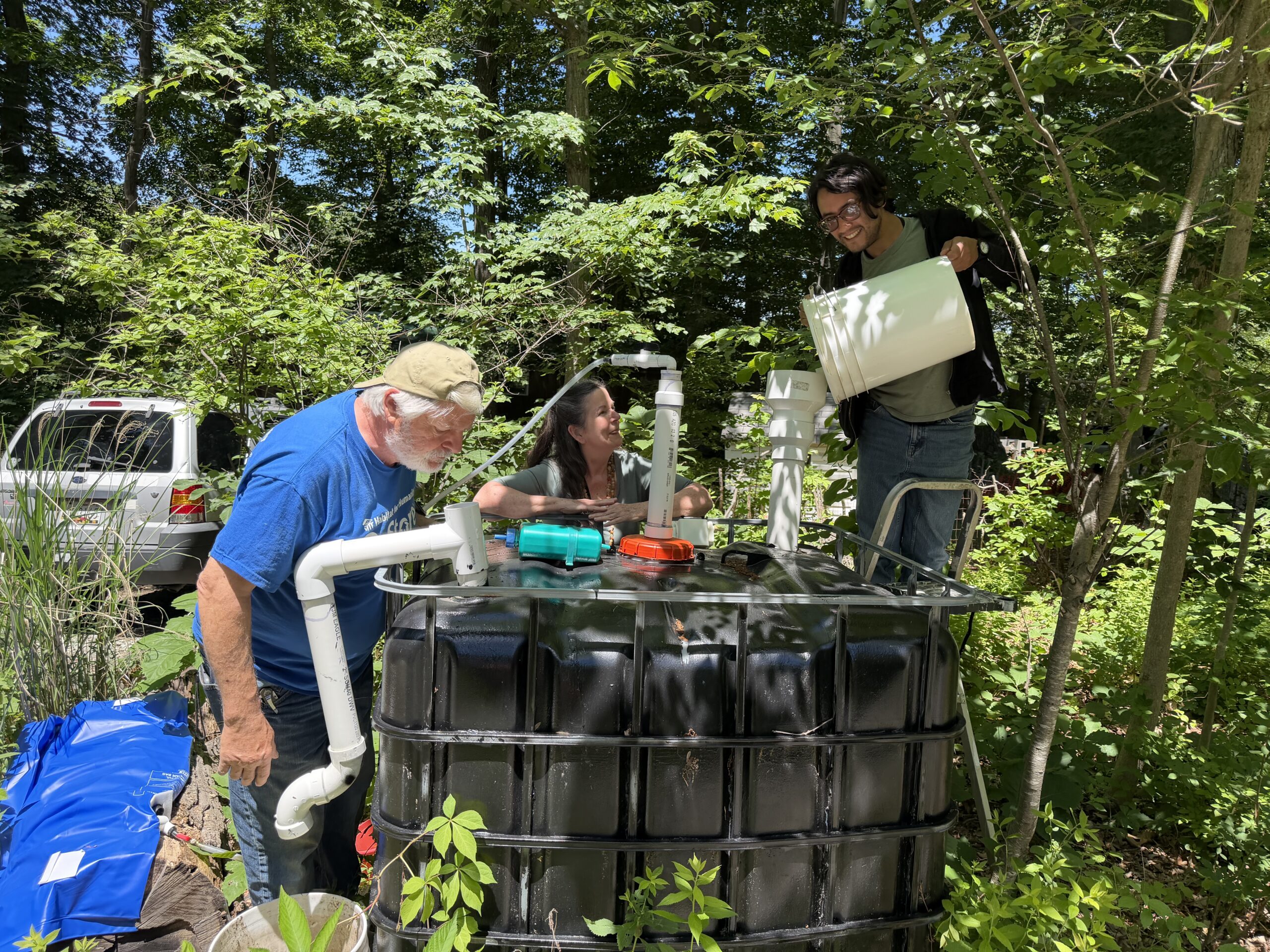
Filling Bill and Pat’s digester with an infusion of microbe-rich liquid digestate from another healthy biodigester.